COMMUNICATION
Most of the people we will be interacting with will speak English. English
is taught as a second language in Indian schools, and very educated
Indians speak it fluently. However, Indian English is inflected differently
so you might not understand people right away until you get used
to the way they speak.
Employees in tourist hotels know enough English to help you get your
needs met. On the street, it's harder to know who speaks English. 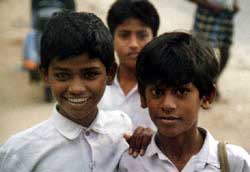 In
large cities many people do. In smaller towns, usually men wearing Western
clothes know at least some English, and men in Indian clothes often don't,
but you might be surprised to meet an English-speaking sadhu (holy man). Kids especially love to speak English and they will come up to you and ask you a few basic questions in English. In
large cities many people do. In smaller towns, usually men wearing Western
clothes know at least some English, and men in Indian clothes often don't,
but you might be surprised to meet an English-speaking sadhu (holy man). Kids especially love to speak English and they will come up to you and ask you a few basic questions in English.
Indians wobbles their head back and forth to indicate that they understand
you or it can mean yes or it can just be a non-committal nod.
Hello and goodbye are done with folded hands, palms together. An overall good greetings "Namaste." If you're being bothered but beggars, politely say "Shanti" which is both a blessing and a request for peace.
EATING
Many Indians
eat without utensils. They use the right hand to mix their
food together, roll it into little balls, and pop them in their
mouth. Before eating meal be sure to wash your hands. Purell is a good disinfectant and all restaurants have a sink (usually prominently displayed) where you can wash your
hands (but avoid the towel). Indians use their left hand for the toilet and don't use it to eat. If you want to follow that custom, keep it
in your lap when you are eating. This can feel awkward when you want
to
pick up bread or drinks with your left hand, so you might have
to imagine that your hand is chained permanently to your belly button.
After the meal. rinse your hands again.
TOILETS
Most of the hotels we stay in will have American style
toilets while others will have the traditional Indian style "squat" toilets.
Train stations usually have Indian toilets.
Toilet paper is usually not provided so either bring something along with
you (such as your own personal roll of toilet paper or Kleenex) or purchase
it once you are there. If you are brave, you can do as the Indians do:
use the tap to your left and fill the large bucket with water. Use the
smaller pitcher to pour
water on your left hand. Use your left hand to clean yourself up. After
that, wash you hands thoroughly with soap, or if not available, with your own bottle
of disinfectant soap or disinfectant pads.
BATHING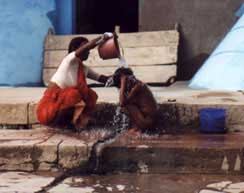
The hotels we stay in should have showers. If not, they
will provide you with a bucket for bathing. To take a bucket
shower, you sit on a little stool and wash up, then pour the
bucket over you. You can splash around and have a lot of fun.
I once stayed in an ashram in Rishikesh. The only item in the room,
other than two small beds and a rickety desk was a bucket. The bucket
was used
to fetch hot water for bathing. I remember grumbling about the inconvenience of having to lug the bucket to the kitchen two stories down. But something
changed inside
of me after a few days. It became so grounding, and even joyful, to
take that bucket to the kitchen to get my hot water. We take so much
for granted
in the US; in India, everything is much more basic and simple
PERSONAL
SPACE
The notion of personal space is very different in India. Once
you step out onto the street, people will immediately begin to
approach you offering to sell you things, perform services, etc.,
or just to ask for money. People will not go away if you say "no".
If you're not prepared for this (and even if you are), it can be
a very intense experience.
Avoid touching or hugging adult Indians, especially if you think they follow
traditional ways or if they are of the opposite sex. If you become friendly with
an Indian of the same sex, they may want to hold your hand; this is not necessarily
anything sexual but rather a gesture of friendship. If kids come up to you, they
will want to shake or hold your hand, and that’s fine to do.
Finally, avoid entering an Indian kitchen or touching the vessels that hold water;
it is considered polluting.
QUEUES
Indian line up in queues for everything. Unfortunately, you have to abandon all courtesy if you ever wanted to be served. If you want to buy a ticket at
the railroad station, you have to "actively queue"–– defend your
position or else someone will simply shove his money into the little counter
window before you, and there will be someone next to him with money in
hand trying to do the same. On the other hand, you may sometimes receive
a little more respect than local people do because you are a foreigner;
this can be useful at times, and distressing at others.
TAKING PHOTOS
If you want to take a picture of someone or a group of people
and it is obvious that you are taking their picture, always ask
beforehand. You can “ask” through words or just point
at your camera while looking at them. Most people love to have
their picture taken. A few will ask for money. A few will refuse.
Do not take pictures of cremation ground; it is strictly
forbidden. Most temples allow pictures but some don't so be sensitive
to local customs.
TEMPLES
Temples in India are very sacred and should be approached
with reverence and respect. When visiting temples, the rule for
clothing is modesty. Dressing in traditional clothing can help you gain entry to temples that normally prohibit tourists or non-Hindus.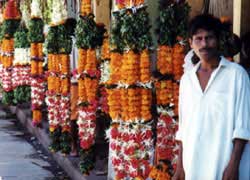
It's
customary to bring an offering to a temple. Flowers and other offerings
can usually be purchased outside the temple. Generally,
leaving some kind small monetary donation at the temple is
appreciated; it helps support upkeep and services.
Before entering a temple, leave your sandals with a sandal "wallah." It
usually costs 5-10 rupees but they'll watch your sandals like a hawk and
usually know which ones are yours when you return. Leaving your sandals
unattended
can invite theft especially if they are anything fancy. Some temple floors
are hot from the sun so it's a good idea to bring a pair of heavy cotton
socks for protection.
Gurumayi suggests the following when entering a temple: "In
India, when we go to a temple, we first pause at the door.
We touch the ground and then
we touch our hearts. We acknowledge that the presence on the ground
is also in our hearts. Then we walk with reverence and devotion
until we come to
another door, and once again, we touch the floor and our heart. Then
finally after going through may doors – that's how temples
in India are often built – you come to the inner part
of the temple. And there, you bow. You take your time; you
bow as long as you want. Then, finally, you rest
your eyes upon the image of the deity. Having purified yourself in
this way, through reverence and devotion, continuously acknowledging
the presence within
and without, then – when you know your eyes have become focused
and are ready to receive the Truth – you rest your eyes upon the
deity." -- Yoga
of Discipline, p. 58.
It
is considered disrespectful to point your feet at a deity or
guru so adjust your posture accordingly.
NEXT>>
|